

The Truth About Studying — And How to Do It Well
🕒 Read time: 7 mins
By Elead Tekie
Getting good grades seems like a simple task to many. Open the textbook. Read the textbook. Remember the information. Sit the test. After following this very streamlined process, you might notice your grades are not where you want them. Why is that?
Section 1: What does it mean to study?
Studying has lost its essence as of late. The internet is overpopulated with videos saying ‘How I got A*A*A* at A-level’ yet when explaining how they actually did it, the screen pans to a very poor revision resource paired with the usual ‘this video is sponsored’. This commoditisation of pursuing an education which we are fortunate not to have to pay for is slowly eroding away at the reasons why people are able to succeed. In reality the two real things you need when studying is a desire to understand and discipline. Just these two will take you to where you want to be.
Understanding
So what do I mean by a desire to understand? It is as simple as it sounds, education rewards the most inquisitive and those that keep asking why things are the way they are. In a study done this year researchers Mediana,Funa and Dio found a very strong positive correlation between inquiry-based learning (IBL) with an even stronger correlation found when students themselves developed their own questions. If this means going back to basics and learning the very principles of chemistry for example, so be it. Sadly, everything only gets more difficult so by mastering the basics you are giving your future self a much stronger foundation to work with.
Something in common with students that pursue a conceptual understanding is the joy of seeing how things link up and realising how the specification for certain courses has been engineered to foster a deeper appreciation for the subject. This can be highly beneficial in exam scenarios, as rather than thinking of the answer to the question, you see yourself beginning to think what the point of the question is: what knowledge is the examiner trying to test me on and what is the most concise way I can communicate this? Being able to do this critical analysis is an indication of a very high level of mastery which is deeply rooted in the simple act of asking why.
Discipline
I myself think discipline is the most important aspect of success at both GCSE and A-level. Let’s face it. A lot of the time the things you may be studying are actually quite boring, it is rare we can always study our favourite topics. And so, like most people, you may see your work ethic and motivation drop as a result. What distinguishes those that have this discipline to those that do not, is that even in these topics that are less engaging, they maintain the stalwart level of effort in their inquiry-based approach. Being able to operate and compartmentalise both motivation and discipline as separate systems that drive us to work, it allows us to rely on one when the other fails. I know that for myself, when there is something that I do not want to do, I become a master of excuses that can find even the smallest reason to further postpone the inevitable. So by having discipline, it allows me to work no matter the scenario and is a constant reminder of the future me that is so happy I put the work in.
Section 2: How do you study?
So how can you put these two ideas into practice? I will dive a little deeper on the practical applications of these concepts and how you can use them in your A Level study (from here I will be a bit more specific to Biology, Chemistry and Mathematics).
Your learning style
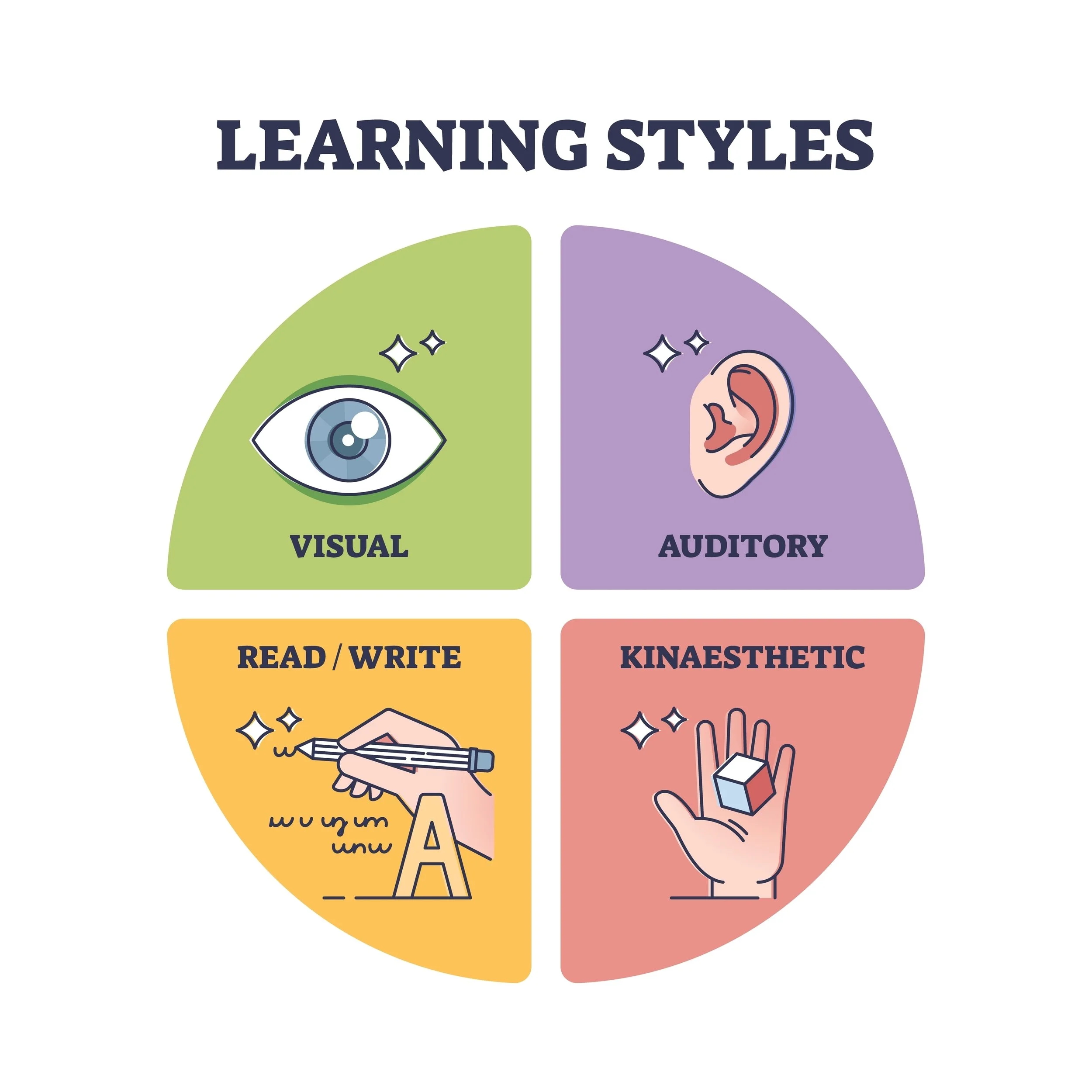
The first step is knowing the best way that you take in knowledge, i.e. what type of learner you are. Research has shown that there tends to be four main types of learners known as VAVK - visual, aural, verbal (also known as read/write) and kinaesthetic. Visual learners may prefer videos, whilst kinaesthetic learners may prefer hands-on demonstrations using playdough. Irrespective of what learner you are, make sure you stick to what works for you and not what works for others!
Finding revision resources
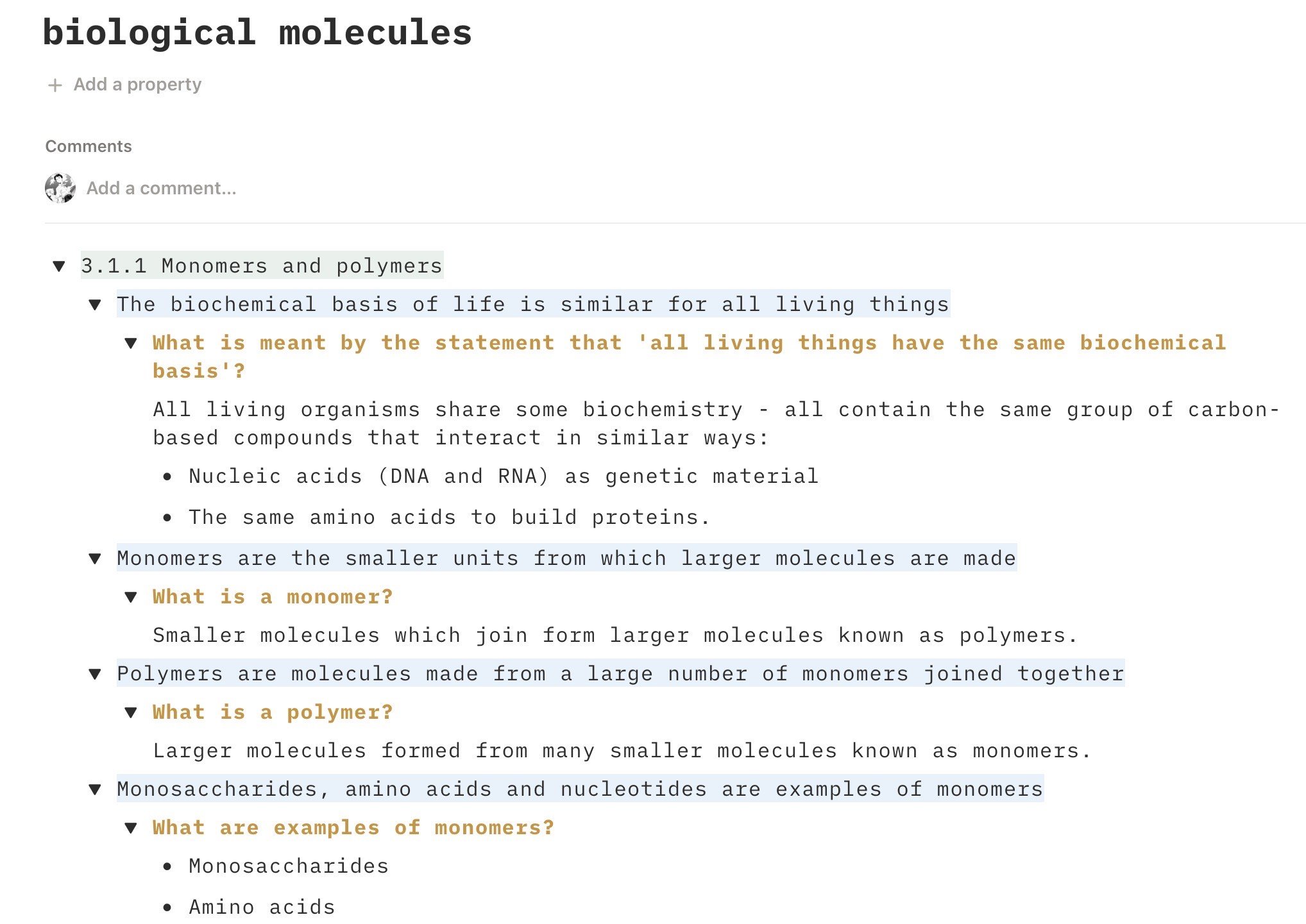
How I used Notion to make a Mind Map.
The next step is finding knowledge. This varies a lot from person to person and it is important to find the way that works best for you and matches your learning style the best. I personally was a fan of youtube videos that explained the concepts from first principles. This included Miss Estruch for biology, Bicen Maths for mathematics and finally The Chemistry Tutor for chemistry. I was also a big fan of some written resources such as Chemrevise and Biology with Olivia which were a lot more concise. However the best way to go about finding the right resource is making your own! Throughout sixthform, I learnt how to effectively use the website notion - a seemingly complicated application that when used correctly can be a very powerful revision tool. Using notion, I made a map of each of my specifications and compiled all of the relevant knowledge in one place. I made sure the wording I used was exam specific and meant if I needed a refresher on the knowledge all I had to do was look here. Doing this trivialised doubts of whether I knew everything that could possibly be tested - thus making revision primarily a memory game. I also used this notion page as an opportunity to unravel any misconceptions that could harm my understanding in the future, making it was also all the revision I needed before a topic test! However, as great as having such a comprehensive page is, it will do you no good if you do not remember anything, this leads me to my next step.
Practice
The third step is long term practice. This step is where the discipline I mentioned earlier becomes the most useful. The best way to strengthen your memory is by using something called active recall. German psychologist Hermann Ebbinghaus uncovers in his 1885 book ‘Memory’ a graphical representation of how our memory declines over a time period - this is known as the curve of forgetting. To overcome this curve of forgetting we need to train our memory in a way that strengthens neural connections just when they are at the highest risk of being lost, this is where active recall and the software Anki comes in. Anki is a flashcard app that implements Ebbinghaus’ curve in the form of an algorithm that shows you cards when they are the most important for your memory. In my experience Anki may seem complicated and ineffective at first, however it highly rewards those that use it consistently, to the point where the app will not recommend you to study a card for a year based on your confidence on it. Consistency and discipline is tough, however after using it for a while I genuinely felt like some of the very long and convoluted cards were ingrained in my memory; the feeling is quite weird but very empowering in exams. As a result of Anki I would actively search for 4,5 and 6 mark knowledge based questions in exams (and 25 mark essays!): these became marks I knew I could guarantee and whilst essentially writing my flashcard out I could think about trickier questions at the same time! Despite this Anki does have its caveats, it requires a long time period to become effective and for those who use it on its own, sometimes fail to build an overall understanding especially if you use cards you did not make and do not regularly supplement with exam practice.
Exams

The final step is applying this in exam scenarios. Doing past exam questions is essential before doing an exam of any kind. In biology for example, you may know all of the content front to back however if you do not include the certain keywords and phrases that examiners are looking for then sadly you will not be awarded any marks. The way to combat this is with exam practice. By doing topic questions before each assessment and all of the full AS and A-level papers before mocks and the real thing (in exam conditions), you really give yourself a good basis in which you can respond to new styles of questions. I also would collate all of the questions I got wrong due to a lack of understanding and made a separate Anki so I would never make these mistakes again, this was extremely helpful.
However, as of late and especially in my exam series, exam boards are becoming a lot more creative to negate the increased use of past questions which is tremendously helping students. This is why I personally approach exams very differently to how I approach normal past paper topic questions. In an exam I look to use 100% of my time, if this means writing more than I think is necessary to guarantee marks then so be it. In my actual Biology paper 1 I wrote a very long answer and only got marks on the very end part of my answer, it is better to be safe than sorry!
In summary, studying is hard, however by following some of these tips and thinking about how you learn best, this process can get a whole lot easier. If you got this far I hope this was helpful and you see the change you want!
References
Anki - powerful, intelligent flashcards. Brainscape Academy. Available at: https://www.brainscape.com (Accessed: 19 November 2025).
Bicen Maths. YouTube. Available at: https://www.youtube.com/user/BicenMaths (Accessed: 19 November 2025).
chemrevise | Resources for A-level and GCSE Chemistry. Available at: https://www.chemrevise.org (Accessed: 19 November 2025).
Effectiveness of Inquiry-based Learning (IbL) on Improving Students’ Conceptual Understanding in Science and Mathematics: A Meta-Analysis. International Journal of Education in Mathematics, Science and Technology. Available at: [insert URL] (Accessed: 19 November 2025).
Ebbinghaus Forgetting Curve (Definition + Examples). Practical Psychology. Available at: https://www.practicalpsychology.co.uk/forgetting-curve (Accessed: 19 November 2025).
GCSE & A-Level Biology Online Tutor. Available at: https://www.gcsebiologyonline.com (Accessed: 19 November 2025).
Miss Estruch. YouTube. Available at: https://www.youtube.com/user/MissEstruch (Accessed: 19 November 2025).
The Chemistry Tutor. YouTube. Available at: https://www.youtube.com/user/TheChemistryTutor (Accessed: 19 November 2025).
4 Different Types of Learners: Which Are You and How to Learn Easier? Learning Mind. Available at: https://www.learning-mind.com/types-of-learners/ (Accessed: 19 November 2025).

Elead is a dedicated Maths and Science tutor currently on a gap year with an offer to study Medicine. As a Tutor and Content Writer for Learn Science Together, he combines his strong STEM background with a passion for helping students succeed. Having achieved A* grades in Biology, Chemistry and Mathematics at A Level, Elead crafts engaging articles designed to spark curiosity, build confidence, and inspire ambition in young students exploring science and mathematics.
