

🕒 Read time: 9 mins
By James Dorman
Careers in Science, Technology, Engineering, and Maths (STEM) are always changing. New discoveries can create entirely new areas of work and new career opportunities. We seem to be at one of those watershed moments of discovery now with the explosion of Artificial Intelligence (AI). This powerful new technology has quickly integrated itself into our daily lives and is reshaping many professions.
If you’re looking to pursue a career in STEM, this isn’t a moment to worry about the future, but it’s certainly a moment to think critically about it. The rise of AI is creating new frontiers, but it is also challenging STEM professionals to think differently about the skills that matter most.
The Future is Now
AI, once the stuff of science fiction, is becoming an integrated, everyday tool. Even the most basic smartphone apps now seem to be incorporating AI and things like Large Language Models (LLMs) have become common across many professions. In a very short space of time, it’s almost become unusual to use a new piece of technology that doesn’t have some sort of AI functionality. In the STEM field specifically, AI’s ability to process massive amounts of data, spot complex patterns, and automate repetitive tasks makes it an incredibly valuable resource that is already beginning to transform the way people work.

AI-powered tools are being used in healthcare, for example, helping medical professionals improve diagnostics by analysing medical images. AI algorithms are also revolutionising research, allowing people to analyse large data sets incredibly fast, test hypotheses, and uncover valuable insights that traditionally would’ve taken human teams far longer to discover. One recent real-world example of the remarkable power of this technology saw AI-powered tools scan and analyse thousands of genetic combinations and compare them against tumour data to find new therapeutic targets for destroying cancer cells.
AI: The New STEM Tool Creating New Professional Demands
One way to look at the role of AI is that it’s something we can use to automate the “easy stuff”. By having it take over tasks like routine analysis and basic processing, scientists and engineers can focus their time on tackling the things machines can’t do. The ability to ask the right questions, design experiments, create, and innovate is something uniquely human, and AI offers STEM professionals tools to support this important work in exciting new ways.
This is actually the heart of the real AI revolution in STEM. For professionals to get the most out of the new tools that are becoming available, they need to develop a valuable new skill: AI literacy. There’s far more to this skill than simply knowing how to use an AI tool. Moving forwards, scientists and other STEM professionals will need to know how to truly understand AI. You’ll need to critically assess the output of AI technologies, asking and understanding whether the data is reliable and the answers are correct. You’ll also need to fully understand what an AI tool can do and, crucially, what it can’t do. Understanding the limitations of these new smart systems is a key part of effectively integrating them, and this is the real goal with these new technologies. If you understand fully how to use it, AI can help you achieve your goals and complete your work faster and, arguably, better.
STEM Careers: Who Is Safe and Who Isn’t?
It’s hard not to hear all the amazing things AI can do and look at the speed things are changing at and not be a little bit worried. Many fear that their jobs will be replaced by AI automation, and that’s not an unreasonable fear to have.
Certain tasks and probably certain job roles will likely be lost to AI automation. But as many challenges as AI might bring, it brings as many if not more opportunities. Many experts agree that AI will create more new roles than it replaces, and core, human skills will always be needed in STEM.
So, to get blunt about things, what STEM careers are safe, and who is at risk?
At-Risk Careers

There are a lot of traditional entry-level job roles in STEM that are built around very process-driven work. Tasks like these are at the greatest risk of AI automation. Jobs like basic data entry positions or junior data processing roles, or any other positions that involve simple pattern recognition, routine data manipulation, or other repetitive tasks are starting to use AI automation. LLMs and other AI systems have already shown to be highly competent at these sorts of tasks.
These job roles probably won't vanish entirely, but they will likely evolve. Replacing these entry-level positions as they currently exist will probably be higher-level AI-era equivalent roles requiring oversight and strategic implementation of AI automation tools.
Safe Careers
Any career that involves uniquely human skills that AI can’t replicate (yet!) is going to be fairly safe from automation. Jobs requiring empathy, ethical judgement, strategic leadership, and complex negotiation will still need human professionals. Roles like research managers, strategists, or fundraisers will probably be “safe” in the AI revolution, as will practical, hands-on jobs like surgeons.
While these jobs will still rely primarily on human responsibility and human action, professionals in these positions will probably still see their job roles change to incorporate AI tools. Even surgeons will have to learn to use new robotic equipment and AI-assisted diagnostic tools to remain at the cutting-edge of their profession.
Brand New Opportunities
AI is a brand-new tool with brand new problems, and there are entirely new careers forming exploring these problems. New disciplines are popping into existence that blend technical skill with human judgement. These jobs require people who can manage AI systems to ensure fairness or bridge the communication gap between technical teams and everyday end-users. You may have already seen advertisements for roles like AI prompt engineers or AI translators. These are jobs that require a uniquely human interaction with these artificial tools to get the most out of them.
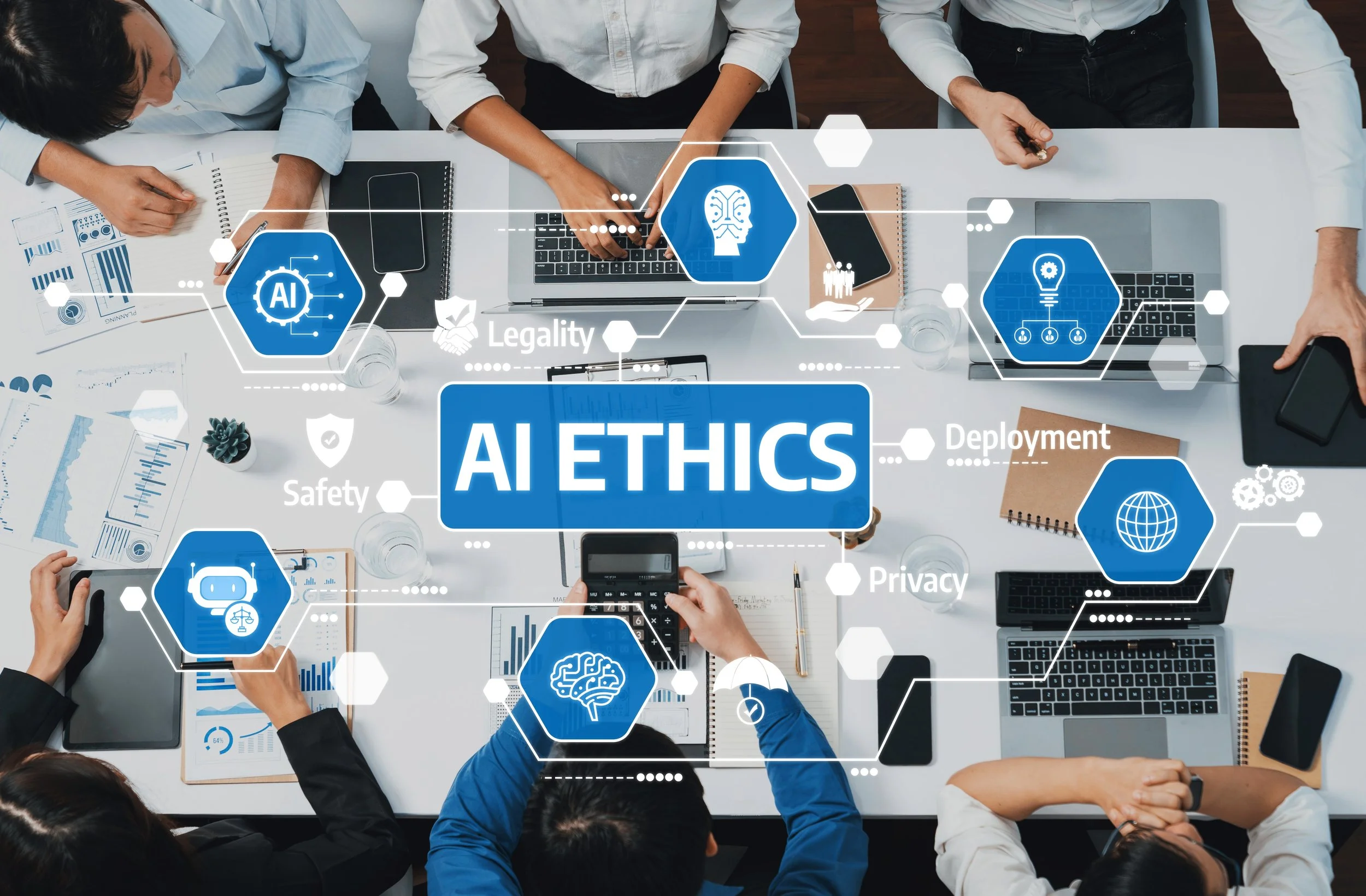
There’s also a lot we don’t understand about AI and plenty of ethical concerns about how it should and shouldn’t be used. AI has already been seen to develop unintended behaviours like resisting shutdown instructions, and people are worried about how using AI in academic research will impact traditional ideas of accountability and authorship. These worries mean there’s an entirely new professional discipline looking at the morality of AI, creating exciting new job roles like AI ethicist and AI governance and compliance manager.
How to Get Ahead (and Stay Ahead) in the AI Era
As a student, you have the chance to get a running start in the AI era. You can look at AI not as a new professional competitor, but a useful new everyday tool, no more threatening that the calculator was when it was invented. Using AI can become second nature and you can focus on developing the thing that will always be your greatest asset: human ingenuity.
Here are a few steps you can start taking to prepare for the future of STEM:
1. Become an 'AI Whisperer': Get a thorough understanding of exactly how to use AI tools by learning to speak their language. Master the art of prompting AI to give you exactly what you need. There are plenty of LLMs and generative AI platforms out there, so start using some to practice how best to define your goals, provide the necessary context, and specify the format you want to get AI output perfectly crafted for your needs.
Also get hands-on experience of how to critique an AI’s output and adjust your prompt accordingly to refine this output. This prompt engineering is a highly valuable skill, so much so that it’s basically become a whole professional industry of its own.
2. Think About Your Human Skills: Focus time on developing the skills that only you can bring. AI can handle processes and answer questions, so train yourself in formulating the problems and knowing what the right questions to ask are. Critical thinking and creative innovation are what allow you to design experiments and use the tools AI provides to advance your knowledge. They also obviously feeds into things like prompt engineering.
Consider maybe joining extracurricular clubs built around activities that encourage abstract reasoning, collaborative problem solving, and other things that AI can’t replicate. Debate clubs or engineering challenge teams can be fantastic environments for this.
3. Learn Coding Fundamentals: It’s not necessary you become an expert, but an understanding of the basics of Python, the most common programming language in AI and data science, could open a lot of doors professionally as we move further into a world that’s integrated AI.
Look for free online courses or tutorials in Python and its data analysis libraries. Being familiar with this helps give you a better insight into Natural Language Processing (NLP), for example, which is at the heart of most AI models.
4. Explore AI Ethics and Safety: AI safety and alignment is a booming new professional field. It’s one that requires input from a lot of disciplines, from coders to philosophers, to make sure AI systems are safe, fair, and used in a way that aligns with human values.
Even if you’re not considering a career in this area, it’s always good to have a rounded view of the ethics of science, not just the mechanics. This is something you can just do as habit. Start thinking and talking about the real-world examples you encounter. Talk about AI bias in facial recognition or the limitations or problems with the way AI learns with friends, colleagues, teachers, and family.
5. Build a Project Portfolio: Theoretical knowledge is good, but practical experience is better. Start using platforms like TensorFlow or Scratch and try your hand at some AI projects. See if you can build something simple like a basic recommendation system or a text classifier.
Simply by completing these small projects, you get a holistic understanding of how AI works and can be used. It also helps you build a portfolio that shows your technical competence and ability to apply your own human ingenuity — the perfect marriage of skills that can help make you a very employable STEM professional.
The New AI Frontier in STEM
As AI changes the professional landscape, it’s creating a need for new skills. As the philosopher Yuval Noah Harari observes, in a world where AI is rapidly changing the job market, the most valuable skill of all might simply be the ability to continuously learn and re-invent yourself. The challenge of AI is not a one-off event but, as Harari puts it, a “cascade of ever-bigger disruption”.
There’s a mental flexibility and resilience needed to unlearn and relearn again and again throughout your life, but this is also an ability that STEM education specifically helps develop. If there is any group best suited to face the challenges of the AI revolution, it’s STEM professionals.
The future of STEM work will probably be defined by a mastery of human-AI collaboration. If you embrace the challenges, it seems there is a world of opportunities. Thismay sound dangerously close to science-fiction, but it is very much science-fact.
References
DataCamp (n.d.) How to become a prompt engineer: A comprehensive guide. Available at: https://www.datacamp.com (Accessed: 18 November 2025).
The Alan Turing Institute (n.d.) Understanding bias in facial recognition technologies. Available at: https://www.turing.ac.uk (Accessed: 18 November 2025).
Google AI (n.d.) Understanding AI: AI tools, training, and skills. Available at: https://ai.google (Accessed: 18 November 2025).
Harari, Y.N. (n.d.) Lectures and writings on the future of work and mental flexibility. Available at: https://www.ynharari.com (Accessed: 18 November 2025).
McKinsey & Company (2025) AI in the workplace: A report for 2025. Available at: https://www.mckinsey.com (Accessed: 18 November 2025).
Michael Page (n.d.) 5 emerging tech roles revolutionising industries. Available at: https://www.michaelpage.co.uk (Accessed: 18 November 2025).
Nexford University (n.d.) How will artificial intelligence affect jobs 2025–2030. Available at: https://www.nexford.edu (Accessed: 18 November 2025).
News Medical (n.d.) New AI-driven approach identifies treatments to reprogram and destroy cancer stem cells. Available at: https://www.news-medical.net (Accessed: 18 November 2025).
Scimex (n.d.) Expert reaction: First conference for entirely AI-authored research papers. Available at: https://www.scimex.org (Accessed: 18 November 2025).
The Guardian (n.d.) AI models may be developing their own ‘survival drive’, researchers say. Available at: https://www.theguardian.com (Accessed: 18 November 2025).
The Joint Research Centre (n.d.) Impact of digitalisation: 30% of EU workers use AI. Available at: https://joint-research-centre.ec.europa.eu (Accessed: 18 November 2025).
Wix Studio (n.d.) The impact of artificial intelligence on STEM careers. Available at: https://www.wix.com (Accessed: 18 November 2025).
Yahoo News UK (n.d.) AI is changing who gets hired – what skills will keep you employed? Available at: https://uk.news.yahoo.com (Accessed: 18 November 2025).

James Dorman is a Content Writer for Learn Science Together. With a BSc in Anatomy and Human Biology and just under 10 years' experience working in the higher education sector, he has a unique perspective to offer those interested in a career in STEM.
